The risk of the ship sagging or "hogging" is real. Tugboats are putting asymmetrical load on the vessel. These things routinely take km to stop, and km to turn. Moving them against a suction force, is trying to break resistance to being moved. Thats.. putting unusual stress on the frame. These things are not done lightly, especially in a fully loaded ship with a high centre of gravity.
No amount of intermodal container stacking is going to offset this, and the containers and mounts are not designed to provide rigidity or load to the vessel in this way as I understand it.
Some quick points from my dad (an expert on big ships, 20 years at PDVSA as a failures analysis engineer and 12 years building propellers for navies in Latin America):
* Work on the ship can most likely only work during high tide. This will prolong the process.
* Many of the floating crane barges necessary to offload container weight function via strict contracts. Even if a ship is 'available' leaving a port early is breach of contract, further complicating the logistics of bringing help. The availability of specialized vessels to assist is essentially random right now.
* It's an oversight that the Suez Canal allows ships to traverse without tug/tow boats with high wind conditions (which probably led to oversteering). The Panama Canal has a more robust escort system that should probably be replicated in the Suez Canal to prevent this in the future.
* The excavators on the shore from earlier today are likely doing absolutely nothing in the grand scheme of things. Offloading weight via cargo and fuel with good tide conditions is likely to be more useful.
* His project estimate to completely remove the ship from the canal SAFELY is six to twenty weeks (worst case) of around the clock planning and operations. Big boats are dangerous and rushing could lead to casualties or even worse blocking hazards.
* The biggest roadblock might be procuring the specialized crane barges. He tried to explain to me what the difference was between the specialized cranes necessary for this ship and other crane ships but it went over my head.
He loves this stuff, so I can ask him a few other questions.
Edit:
* I asked him about the helicopter idea and he likes it as an aid to a larger crane operation. He doesn't know much about helicopters, but he does believe that with the right weight/container distribution it could help speed up the process significantly.
Can you ask him what he thinks about using cofferdams for raising the water level ( instead of lowering it).
I'm actually curious in hearing potential problems or ( if it would be plausible) a raw estimation of duration ( since you mentioned 20 weeks, that's a huge timeline).
Edit: I don't know anything about this subject. So it's interesting to learn/ask some stuff I wouldn't encounter otherwise.
He didn't estimate timeline, but it would take longer than a weight/crane operation. If the situation was much worse (partial capsize, somehow deeper entrenched on the coast), this might be a more plausible option. With the containers in an accessible location, it should be faster to organize a weight redistribution campaign instead. Just thinking about the logistics of safely building and deconstructing the dam made his head spin a little bit.
Its way longer than that - the other thing is to think about the economic ripple effect - short, mid and long term.
Also its important to note that the evergreen is now out of commission for at least a year.
It will likely go to another closer port, all cargo offloaded to other ships, then it will go into dry-dock for in depth inspection for fatigue and micro-cracks in the hull and infra...
This guy: GCaptain sounds very similar in experience as your pops.
He goes into detail on a lot of the same points your dad makes.
He specifically says that its unbelievable that the Suez didnt have the appropriate bollard pull tugs or pumps available as a matter or course...
---
SMIT is the salver for the project, they are going to slurp the ballast, the fuel and are dredging under the front bulb.
however the EVERGREEN is *FLOODING* according to GCaptain based on the immediate request by Suez for highspeed pumps for the forward empty space - he thinks the forward steering props are leaking into the forward empty space. They also called for them for aft...
He goes through the various least worst and worst scenarios. Talks a lot about micro cracks and flexion, sag and hog...
Also its important to note that the evergreen is now out of commission for at least a year.
It will likely go to another closer port, all cargo offloaded to other ships, then it will go into dry-dock for in depth inspection for fatigue and micro-cracks in the hull and infra...
The problem with crane barges is that there may not be one that is tall enough to handle the EverGreen.
Anyway - send this guys vids to your dad - He would like them.
One thing is for sure - every single timeline for every manufacturing operation in europe, relying on parts from china just got pushed back by ~3 months
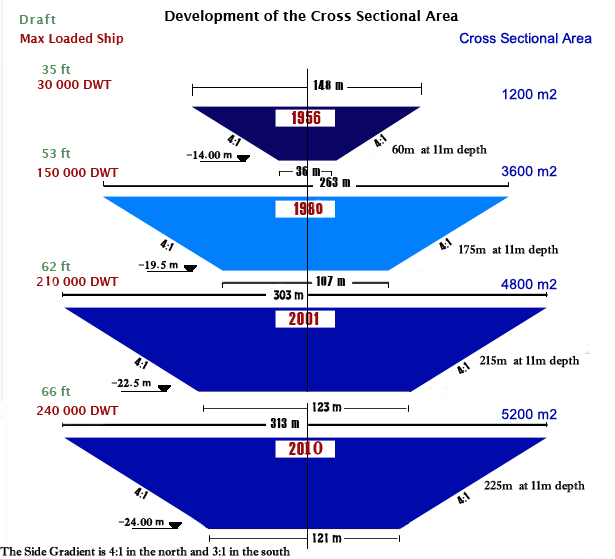
The drawings are not at all to scale making it hard to comprehend the issue.
The ship has a draft of 16m. the canal is 24m deep in the 121m wide fairway, quickly becoming shallower outside. This allows for the navigation of ships with up to 20m draft.
For extra credit assume some block coefficient and calculate how much sand was moved pushing all the way up to both banks.
Both sides are firmly stuck in the banks. This means unloading containers until the front of the ships starts to float again will tip the vessel aft lodging that side even harder. Same with the reverse. So to do that you would need to unload from both sides to not risk cracking the hull or make one side more firmly stuck. Therefore likely unloading from the middle also.
Now you need barges and cranes. The vessel is 60m wide and the height is about 70m, say 60m to the highest container. A container may weigh up to 30 tons. It's an awful operation.
Wikipedia says: As of 2016, the Mi-26 still holds the Fédération Aéronautique Internationale world record for the greatest mass lifted by a helicopter to 2,000 metres (6,562 ft) – 56,768.8 kilograms (125,000 lb) on a flight in 1982.
That is 56.8 to 62.5 tons, depending on the type of ton. Lift two containers at once.
Rebuilding the entire drive train between each lift. The spec says 20 tons in regular operations. Maybe some more switching fuel for payload, but then you need to spend more time refueling and transiting.
How about: 1: create a THICK cushion that wraps around the entire ship using tires or some other items in bulk, wrapped in enough "netting bags” to maintain consistency of distribution. 2: Create a stable and thick “wall” (potentially using barges placed end to end horizontally with thick steel plates welded together to form a smooth surface, then park the barges next to the ship on both sides. 3: line up tugs properly distributed to maintain stress limits/stability of load, 4: Based on calculating required MTOW, stress and tensile factors, etc., determine the quantity of available military heavy weight helicopters, like the largest (Russian MIL MI-26) which has an MTOW of about 124,000lb, or, less capable but more likely available the American CH-53E Super Stallion, with MTOW of 36,000lb, with several likely aboard nearby US Navy ship. 5: based on number of helicopters distribution of stresses, safety, maximum length, etc, secure or engineer on-site the most suitable wound steel cables to use as tow lines will will be attached to each Heli. 6: Determine optimal distribution/placement of Helis based on all factors and attach them where they will be most suitable, whether evenly distributed on one side, fore or aft, etc. 7: Determine optimal “push points” on ship and create a very large floating inverted “V”, that is sufficiently wide and tall enough to enclose X number of tugs, using baffles to keep tugs astride within the V, so that their combined force will be directed specifically at those points, with cushion/baffles and barge “walls” serving to optimally spread the load without stress. Possibly use two sets, one on either side, fore and aft to counter or offset the rotation/stress of each other. 8: Calculate precise coordination of move, using Heli’s to assist in two ways; “lifting” the ship as much and with as little stress as possible and slowly towing the ship in whichever direction is optimal as tugs push the ship in desired direction, applying offsetting pressure on both sides. 9: reopen Suez Canal, justify costs by comparing to last revenue and finally, 10: drink heavily in nearest port bar. Just a thought.
Note: Obviously this all assumes that any one of the steps is feasible, whether it be maximum towing capacity of helicopters versus that required to lift a trillion ton ship an inch off the sand, availability of them, etc. I also considered using British made VTOL Harrier Jump Jets, which, in theory (and I have so far found not a single article even addressing the possibility) could hover as Helis and slowly ramp up speed enough to be of any use without snapping cables or breaking ship. They can’t maintain hover for too long and can’t be too close together, but their potential combined lift capabilities seem worthy of consideration. Plus it will likely be easier to secure as many as needed relatively quick. Also, be VERY helpful if an aircraft carrier could make its way up the canal as close as possible.
The second to last image is interesting because you can see that the water line is not level along the side of the ship - perhaps its momentum caused it to run up a bit? It's hard to tell the scale but they may need to dredge a volume of sand/dirt (estimating) 10m x 60m x 100 m or 60,000 m^3. If they get the dredgers in place they might be looking at 3 days of dredging, if my estimate of 20,000 m^3 per dredger per day is correct. What a project.
I was looking in to to lifting containers with a helicopter. A Ericsson air crane can lift a light container but not a fully loaded one. Sucking the sand away, seams like the most reasonable alternative.
The weight of every container is known. Placement on the ship is carefully determined by computer so that the ship does not capsize or split. The heavy ones would be at the bottom.
This guys channel is fantastic. Check out his other Suez vids - he is a maritime expert, former huge ship captain and very very good at explaining all the concepts.
For smaller salvage operations, salvage tubes (basically balloons) are often used to raise the ship off the bottom. I suspect it's impractical due to the immense mass of this ship, but part of me wonders how large of a balloon you'd need to stick under the bow and stern to refloat it.
My favorite part of this whole thing is “if I were a canal this is how I’d solve this”. My favorite suggestion so far has been that boats shouldn't need their bow so they can detach it.
The part of the bow causing the most trouble is a bulge that sticks out to the front. Shipping companies sometimes add or remove the bulges as needs change regarding ship speed. That suggests that it could be cut off without sinking the ship. There is equipment that can cut through a ship with a big chain.
> I wonder at what point the operating cost of those waiting leads them to just unload and destroy the ship?
(1) as I understand the effect of how it is stuck, you have to unload very carefully or you destroy the ship in the process, well before you are done, and
(2) unloading a massive cargo ship like this anywhere but a specialized port designed to handle such operations (even if it's not, say, stuck on both sides crossways in the Suez Canal) is...well, perhaps not technically impossible, but not an “oh, sure, we’ll just do that and get things resolved right quick” option.
Can they try tugging from the ground? A tug boat's tug force is limited by their engine thrust. Maybe they can setup some tugging system near the banks.
That looks like some sort of holding pattern, which would be done to prevent having to drop anchor (if even feasible to do so where they were). Plus, there's all sorts of other lines in that diagram, Vice just chose to ignore everything except the crude joke they wanted to make.
Thanks Arrath for mentioning sheet-pile coffer dams.
Edit 2: it seems that timer crib coffer dams are supported for 10-20 meters deep and diagrapragm or cellular cofferdams are used for more than 20 meters.
This is the most precise estimate that I could find on duration of construction for a 2100 foot ( 640 meter) cofferdam with a limited workforce ( 16 days! for probably a less sophisticated cofferdam) https://engineering.purdue.edu/CEM/people/Personal/Halpin/Si...
So, while my suggestion is plausible to execute. It could take too long ( planning + execution).
I guess we'll find out if the current solution will work within the current time-frame, since they have a huge amount of dredging to do.
Do people on Hacker News genuinely think they’re able to come up with tractable ideas that wouldn’t be considered by the actual experts working on the problem?
This person wants to build a damn, someone else wants to use helicopters... waiting for other patronising armchair engineers to weigh in with other reasons why the experts have it wrong.
If I'd explain it as using cofferdams ( temporarily structures) to raise the water instead of the traditional lowering. Is that better for you?
I'm 100% sure that using simple solutions to hard problems is not always thought off when something is not used in it's "traditional" sense.
Sometimes outsiders give another POV that could be actually useful. And sometimes it isn't.
No need to get rude for that... Perhaps try some constructive feedback on why it shouldn't work next time? :)
PS. Before you misinterpret my words again. I'm saying that the concept is simple ( raising the water level), not the execution of it. Since on this scale every solution is harder to execute.
Random person on internet confused about why professional engineers haven't taken note of the idea they just came up with. It's either patronising or delusional - take your pick.
Or perhaps the wording was off as their (my) reason to copy-paste most if it from something they wrote a minute before that on another and highly relevant thread.
You ought to relax a bit. You could, theoretically, just let some random people on a techy forum geek out about disasters and engineering. Since no one is listening to us except ourselves, exactly what do you hope your scolding will accompish?
But the parent comment was pretty gently put. I didn't read it as armchair criticism, but rather more wondering aloud. The idea of cofferdamming the ship is entirely feasible, and I too am curious about how it compares to other interventions in terms of time and effort.
> He didn't estimate timeline, but it would take longer than a weight/crane operation. If the situation was much worse (partial capsize, somehow deeper entrenched on the coast), this might be a more plausible option. With the containers in an accessible location, it should be faster to organize a weight redistribution campaign instead. Just thinking about the logistics of safely building and deconstructing the dam made his head spin a little bit.
For that to work, the dam has to go all the way around the boat, all the way to the bottom of the canal, and create a water-tight (or close enough) seal. That's non-trivial. And then, once the boat is unstuck, then your dam is blocking the canal, and has to be removed, all the way to the bottom, or it becomes a hazard.
Sheet-pile coffer dams are a solved problem, but it would take a good amount of time to drive all the piles. Not to mention that removing them again afterwards is not a speedy process, either.
Going to the bottom of the canal is "only 24" m. The video I gave before shows some ideas on how to do it.
Quick thought: A skeleton where the bottom layer is filled with wooden poles ( to stick them firmly in the ground). The rest is a construction that is quicker to create.
The ground of the "canal" could be 3D mapped for precise measurements ( a company i know does this).
And you'd need some additional meters on top of this to raise the water level.
The canal is very wide, very long, and very deep. It would take an enormous amount of mass to accomplish what you propose, and an even bigger effort to clear the debris afterwards to ensure safe passage of other ships.
The canal is a minimum of 80 feet deep and over 254 feet wide (a lot wider actually, 254ft is the max boat beam it can handle). It's a little bigger of an issue than dropping some telephone-pole sized rods into the canal.
It's one of the most highly trafficked canals in the world, I'm certain if the solution was this simple they would already be doing it.
Using traditional things ( eg. Cofferdams) for non-traditional uses ( raising water instead of lowering) aren't always considered by the same experts.
The problems that I heard of till now are logistics and duration ( since it also has to be removed). None mentioned the depth/length since it is doable and had been done ( cofferdams, but with more planning ofc)
It could have been more plausible if the problem was worse though.
> Using traditional things ( eg. Cofferdams) for non-traditional uses ( raising water instead of lowering) aren't always considered by the same experts.
True but I guarantee you that's not the case here. Any engineer who's familiar with canals will have coffer damns in the front of their mind, because that's exactly how locks work. And besides that, it is (forgive me), kinda obvious.
I promise you the people working on this have thoroughly explored the possibility of raising the water level, probably by more means than you or I can guess.
Sometimes, obvious things have to be said first before it becomes obvious.
I don't know if they'd raised the water with cofferdams before, i checked online and haven't seen an example ( didn't knew the term at first either). I also didn't see it proposed before or mentioned in any related articles.
It's possible that it was done in the past and is a known thing among experts, but i can't really know that, can I?
I guess if you’re this convinced that you have uniquely thought up and proved this idea the only thing left is to phone them up and let them know you’ve got a solution ready to go! There’s a phone number on their website.
Who said I'm convinced that i uniquely thought of that?
What's wrong with you? This isn't your first demeaning comment.
This is literally a place where people tend to discuss/propose things on and get feedback. HN can give a unique insight of commenters that ARE experts on the topic, even while the poster is not. Not many people here see issues with that.
I also said that the engineers would know better than me in the same comment. I've never claimed to be an expert and I've made that pretty obvious from the start.
While my original comment could have been worded better, which I already admitted, your reactions aren't a work of art either.
Calling it delusional and patronizing, while both methods were deemed feasible afterwards, for example. Take your pick.
My intention was always to find out the variables surrounding it and how to make it work and I think most people probably realized that. ( the "badly" worded comment only received -2 fyi, it's just more than what I'm used too)
PS. Some people also disagreed with your perception and told you literally to relax a bit. If you really want to go down that road... ( Didn't I already mention something about your demeaning comments just now?)
My first comment mentioned that you misinterpreted my words. Someone else disagreed with your perception. Someone else said to relax. I pointed out multiple times, that my original comment was badly worded.
Have you even considered the possibility that you misinterpreted the original comment, where you based your toxic reactions on?
Perhaps consider that the "proposals" I'm talking about in my original comment, ARE NOT what is currently being done now in the Suez Channel by the experts (eg. Dredging). Those aren't proposals, that's what currently is being done! But what has been suggested here on the different threads of HN.
I was genuinely eager to see alternative implementations of that concept ( raising water) proposed somewhere.
I copied my example of the other thread as a proposal ( = dams), which led me to the path of water based cofferdams and some other interesting google searches, thanks to comments here.
Completely uninformed guess is that what they're doing is faster and cheaper, and the "get it unstuck enough" point will be reached sooner.
> Concrete is dry in 24-48 hours.
Sure, but building a dam around the entire ship? How much concrete are you going to need, and how long would it take to build? They're pumping sand and dredging right now, today.
The Ever Given being stuck is both easy to understand what's going on, and why it's important; However it's hard to understand why it wasn't easily fixed.
This seems to be a good recipe for a viral news story. The Suez Canal has enough name reputation to be at least heard of world wide. The pictures of both the boat simply blocking the canal, and map of all the ships waiting to go through clearly demonstrate the problem.
However, I'm finding the response to this laughable. Sure they tried tug boats, but after that didn't work, what are they doing? A single backhoe? Given the importance of this shipping lane, why hasn't every dredging boat in the Mediterranean already been put to work? Can't they at least found a second backhoe?
They've engaged some of the most qualified folks with regard to major ship salvage and are working on it. In the mean time, they're trying to do what they can with what's available.
It's exceedingly obvious given the scale, importance and national coverage of this that the issue isn't that they can't find a second backhoe. Your condescension isn't warranted at all.
To make my point more clear: It's not condescension that they're unable to find a second backhoe. I 100% believe that the people solving this problem are doing a way better job than my armchair analysis can provide.
What I'm finding interesting about this story is the juxtaposition of how easy it is to understand the problem, but how far from the apparent response the "why don't they just...?" questions are. It seems to be a good recipe for becoming a viral news story ripe for repeated updates.
That's pretty uncharitable. When I saw that little backhoe in front of the building-sized keel, I laughed out loud. But I know it's the best they had at the moment, and I'm sure they have more backhoes on the way.
I read the parent comment as that sort of laughable, not in the derisive sense.
YES. but also no. it's not simple incompetence. humanity adapts to the problems at hand. the frank matter of the situation is that however many backhoes we throw at this, it's probably not really an effective solution.
the tumblehome hull's top is largely visible dug out, from the one hoe. there have been enormous amounts of fuel/energy burned trying to haul this ship out. but it still hasn't budged. about 1/3rd of the canal, on the east side, is simply not deep at all, and that, likely is the root cause problem here: the ship didn't just hit the wall, it's whole front quarter has run aground.
the new discussion is about unloading & lightening the ship, trying to let it rise up, & free itself. that seems like a solid-ish plan. but it also seems kind of weird & slow, a lot of unloading & re loading. maybe it'd shake out better in the end. but what seems like the capability that i want to have is the ability to dig this ship out effectually. not with a bullshit loader we'd use for any other (land based) earth moving task. which is obviously not working here. which will never ever help with all the massive amount of earth underneath the EVER GIVEN. there's a clear, resonant answer here, one that makes sense, and it's weird, but the answer is drone swarms. a modest number of underwater earth movers, that can effectively target moving the earth that is needed to be moved. a back hoe on land has a modest reach, little ability to help work a way underneath EVER GIVEN. the ability to get something, anything, into the actual situation, to start digging underneath this problem of being run-aground, seems like the most direct & sensible approach, yet we seem simply to be lacking in means & methodology to do so.
that's not really "incompetence", although certainly such sharp criticism makes sense. we haven't really seen a lot of situations like this before. the world's kept it's shit together. so it makes sense that we don't have a bunch of well prepared, coherent, sensible responses lined up, that can directly address issues. to me, that makes this not a problem of incompetence. but, i hope in the future, a better response can be mustered.
There's obviously a lot more going on than "a single backhoe". The articles says "it will take a combination of dredging, tugging and removing weight from the ship to free it", all of which is being actively worked on.
> However it's hard to understand why it wasn't easily fixed.
This feels like the type of comments you read when a major internet service goes down. As if resolving a major problem is just a matter of going into the basement and flipping the server on and off.
Problems are always more complicated than they look from the outside, and there's almost always a good reason it wasn't "easily fixed".
Transporting heavy equipment is really difficult and slow.
Suppose we want the very best. Let's put Bagger 293 by the stern and Bagger 288 by the bow. Come up with a plan to transport those from Germany to Egypt in a few days.


https://www.youtube.com/watch?v=PmlTk_3NN_g shows flexion in a ship during a storm in the indian ocean.
https://www.youtube.com/watch?v=89Mw6L69b6Y is less spectacular but also shows how un-rigid these boats are.
No amount of intermodal container stacking is going to offset this, and the containers and mounts are not designed to provide rigidity or load to the vessel in this way as I understand it.