At this point, for europe it might just be a better idea to let the TGV network grow outwards from France. It's already started to spread its tendrils in other countries anyway.
Not that the network is that good in France though, Paris-Lyon-Marseilles has been nice for years, the connection to Lilles (and now to Bruxelles in Belgium as well) and to London via the channel tunnel is nice, a line recently opened to the east of the country (Strasbourg) but the TGV network has a few glaring issues:
* Everything goes through Paris. Lyon-Paris takes 3 hours, Paris-Strasbourg take about the same time, but a direct from Lyon to Strasbourg (not via Paris) takes 6 hours even though there is pretty much the same distance (~450km) betweem all of them (yep, Paris-Lyon-Strasbourg almost forms an equilateral triangle). Likewise Paris-Marseille (800km) takes 4h but Marseille-Nice (south-east to south-east but further east, 200km) will be 3h30
* There are no LGV (high-speed train lines) to western France, they stop at Le Mans and Tours (200~250km from Paris) so travelling from Paris to Marseille (800km) takes 4h, and Paris to Bordeaux (550km) will take you 4h as well (as the TGV has to use regular lines for half the travel). Paris to Toulouse (670km direct, 780km via Bordeaux) will waste at least 7h (TGV to Bordeaux then regional train).
Thankfully this is changing, there are new lines in the work and projected to start solving this issue (see dotted lines: http://en.wikipedia.org/wiki/File:France_TGV.png) and overall TGV is awesome, but it's nowhere near perfect right now.
PS: I note that my timings differ from Spiegel's, I got mine from the SNCF database so...
PPS: For those unfamiliar with french geography and cities, Paris is of course the french capital (inner city population 2.2M, 11.7M including suburbs), Marseilles is France's second biggest city (852k inner, 1.6M metro), Lyon comes third (472k inner but 1.75M metro), Toulouse is the fourth biggest (437k inner, 1.1M metro), Nice stands at 5th (348k inner, 990k metro), Strasbourg 7th (273k inner, 638k metro) and Bordeaux is 9th (250k inner, 1M metro)
At this point, for europe it might just be a better idea to let the TGV network grow outwards from France.
I doubt that would solve the problem where political wrangling is the issue. I especially can't see the Germans allowing the French to build and run their trains and lines. ;)
The ICE has run to Vienna for a while now, and Austria's ÖBB recently started their high-ish-speed "Railjet" [1] service (vmax currently 200km/h, due to increase to 230). Both suffer from the same network problems as Germany - trains pass through far too many smaller towns; old tracks. Plus there's the additional difficulty of the Austrian geography. The Vienna-Munich/Frankfurt route runs through one of the flattest parts of Austria, much of the rest of the country is covered in mountains.
They are building bypasses (mainly colossal tunnels, as "flat" around here still is pretty hilly) but it takes decades and consumes a phenomenal amount of taxpayer money.
Your point #1 is the inherent problem with rail passenger transport, and why air travel has an advantage. For rail you have to engineer and build both the vehicle and transport medium (rails). This gives you two very different engineering challenges. Building the transport medium between every two points is a new undertaking. Air travel on the other had presents one engineering challenge, creation of the vehicle. (I'm dismissing the airports, because essentially they are very simple structures. Of course the air traffic control system is not simple.) And when you have the vehicle your choice or routes is practically unlimited.
I am not sure I agree here. It seems to me this is an area where restrictions have both benefits and drawbacks.
Rails seem much more efficient, safe, and have faster terminal service. Riding on any good rail service is vastly more enjoyable to the passenger than flying. I would rather travel Europe, Asia, and North America on high speed trains than by air.
> At this point, for europe it might just be a better idea to let the TGV network grow outwards from France. It's already started to spread its tendrils in other countries anyway.
You can make the same argument about the ICE network.
> You can make the same argument about the ICE network.
Nope. First because there are big issues with ICE in germany alone, the program isn't in its best shape where TGV is proven and pretty healthy, and second because TGV has already started expanding its network into neighboring countries.
You may be right about the first points. I only wanted to say, that the ICE network, too, has started expanding into neighbouring countries. You can go from Paris to Frankfurt by ICE. Or to Switzerland, or Brussels.
A accurate portrayal of the problems, but I would very much like to add that actually going to places with a ICE really is a joy. I always prefer it to traveling by car, even if I have to travel some part of the way with a slower regional train.
(That might be because traveling by train is just plain cool, period. I once took that Russian night train to Krakow – that was a unique experience.)
That Wikipedia graphic looks a lot better than the Spiegel one. Well, maybe we're complaining on a high level. That doesn't change anything about the ridiculous stops mentioned in the article.
The really cool trip is the one from Copenhagen to Hamburg on the ICE - they actually load the entire train onto the ferry, kick you off it for an hour so you can swan about on deck, and then it's back onto the train once you dock. Very cool.
We rode ICE from Berlin to Rostock last week and it was an absolute pleasure. It's funny (sad really) how taking trains in Europe is second nature when I'm visting, but you don't even consider it in the US.
this article is a good demonstration of the all-or-nothing big-government requirements of high speed rail.
In the two countries which have working, effective, high speed rail networks (France and Japan) it cost billions, took many years and required 100% government commitment to achieve. Only a few countries have the political setup to achieve something like that.
High speed rail is breathtakingly expensive, especially in urban areas. When BART was planning on a high speed branch out to silicon valley, it was budgeted to run $120,000,000 per mile of track. Part of the cost is that you cannot have any at-grade crossings, every road crossing has to be an over/underpass.
Expensive yes, breathtakingly no. The recent LGV Est (http://en.wikipedia.org/wiki/LGV_Est) has a budget of 4b€ for 406km (252 miles) or about $20m/mile. London's M25 projects £6.5b for 117 miles, so urban motorways are not cheap either.
Completely urban stuff is very expensive, but usually HST is mostly out of urban systems, only getting in to land at a given stop and getting out just as soon.
In Germany, there is also a problem that many of these new lines are expected to have mixed traffic on them, meaning both fast passenger trains and freight trains. This makes them much more expensive than they would have to be, as both types of traffic have quite different expectations. Passenger trains need curves with very large diameters (~ speed^2 relation, even 7 km diameters) in order to allow the high speeds. Freight trains aren't that fast, so they don't need such a large diameters of the curves, but they can't handle as steep gradients. 4% slope is perfectly OK for an HS passenger train, but at least impractical for a freight traffic.
French HS train lines are for passenger traffic only, they can be (and are) built adjacent to existing highways and so. And of course. They are built as whole new lines, instead of the (not only) German patchwork.
Btw. you are missing HS railways in Spain, where it is built in a similar manner to France, there are already complete operational routes, and the service seems to be very successful as well.
> French HS train lines are for passenger traffic only
Not 100% correct, the postal service have a pair of trainsets they use for mail.
But yes, mostly the french HST is for people, not freight.
> Btw. you are missing HS railways in Spain, where it is built in a similar manner to France, there are already complete operational routes, and the service seems to be very successful as well.
Correct, the AVE (which is built in a similar manner to France because Alstom got the contract for the first generation "Class 100" AVE in fact the class 100 is basically a Eurostar) and the two network should be linked (so you could take HST from Madrid to Paris) by 2013.
That's still fairly reasonable compared to interstate construction costs in a city.
For ~30 Billion you could build a DC to NY line that runs through Baltimore and Philadelphia.
"The Big Dig was the most expensive highway project in the U.S.[2] Although the project was estimated in 1985 at $2.8 billion (in 1982 dollars, US$6.0 billion adjusted for inflation as of 2006[update]),[3] over $14.6 billion ($8.08 billion in 1982 dollars)[3] had been spent in federal and state tax dollars as of 2006[update].[4] A July 17, 2008 article in The Boston Globe stated, "In all, the project will cost an additional $7 billion in interest, bringing the total to a staggering $22 billion, according to a Globe review of hundreds of pages of state documents. It will not be paid off until 2038." http://en.wikipedia.org/wiki/Big_Dig
PS: It was probably not worth the cost: "The result was a 62% reduction in vehicle hours of travel on I-93, the airport tunnels, and the connection from Storrow Drive, from an average 38,200 hours per day before construction (1994–1995) to 14,800 hours per day in 2004–2005, after the project was largely complete.[28] The savings for travelers was estimated at $166 million annually in the same 2004–2005 time frame.[29] Travel times on the Central Artery northbound during the afternoon peak hour were reduced 85.6%.[30]"
Perhaps slightly off topic, but I have to disagree - your postscript only looks at one aspect of the CA/T, there were other effects as well. For starters, the old elevated artery was way past it's useful life, and a replacement was absolutely needed. Once you realize that the elevated artery needed replacement, your options start to narrow very quickly: replacing the old elevated artery with a new elevated artery would have been more disruptive than the tunnel construction, and building a new highway in a separate location was feasible since there was no where else to put it. Digging an expensive tunnel was the least bad of a bunch of bad options, but frankly the city was paying for a bunch of stupid decisions that were made in the 1950's.
As for the positive effects of the Big Dig, it reconnected Boston with the water front, it freed up recreational land, it had a positive effect on Boston's air quality, and it significantly improved automobile traffic flow by separating out local traffic (which runs on the surface) from thru traffic (which runs in the tunnel) where before they all moved on the elevated highway which worsened congestion. Before the CA/T opened, this route:
would take a minimum of 90 minutes; double that estimate if you were traveling during peak hour. Triple it if there was an accident in the area. Right now, it's a 20 minute drive in non-peak hours, and well under an hour during peak times. Not bad.
That said, it would have been nice to have had more expanded transit to go along with the Big Dig. The Silver Line and the Old Colony lines (which were required as mitigation for the Big Dig) was a good start, but we could have done better.
(ftr, I worked on the Big Dig as a consultant from 1998-2001. I've also worked on several dozen domestic passenger rail programs, include T-Rex, BART Silicon Valley Extension, and the Acela mentioned in this discussion)
"Boston city proper had a 2008 estimated population of 620,535" 22,000,000,000$ / 620,535 = 35,450$ per person, for something they helps in some areas but made congestion worse in others.
Other options included reducing the number of cars large toll to get into the city which would for high quality and public bus system.
2% of 22billion is 440 million / year that pays for one hell of a public bus system. Heck, spend 22billion on an above ground mono rail network and you could build one hell of a system (~500 - 1500km). Most Boston traffic is just moving people from point A to B so public transportation is a real option. 13% of all commuting takes place by foot as it is, so even elevated bike paths could have significantly improved things.
"Boston city proper had a 2008 estimated population of 620,535" 22,000,000,000$ / 620,535 = 35,450$ per person, for something they helps in some areas but made congestion worse in others.
The presumption is that the artery is only being used by Boston residents. It's used by Boston residents to get out the city, by other MA residents to get into the city, and by non-MA residents to get in & thru the city, as well as delivering goods received in Boston ports to points north, south and west. Freight rail can (and does, vis the huge CSX yard in Allston) move a huge portion of that load, but you're still going to have trucks for the last-mile delivery to the industrialized areas in EMass. (and where has it made congestion worse?)
But even if you want to put everyone on buses, those buses still have to drive on something - the old artery couldn't be that something because it was falling apart, and alternatives have the same problem as an alternative highway system does. IOW. you're still talking about a tunnel system.
It is 3x the cost of light rail (which only goes 50mph) construction in a city.
It is 4x the cost of highway construction in a city.
In an urban environment, land acquisition is the most expensive part of the cost of large construction projects.
We've had one successful large construction project (T-REX) here in Denver that involved both highways and light rail. It was completed 4 years ago, on time and under budget. At that time, the light rail construction costs were about 20 megabucks/mile. The cost of construction materials have shot up since 2006 and the next large (FasTracks is almost all light rail) construction project is currently running about 50% over budget (official estimates) to 100% over budget (unofficial estimates).
http://en.wikipedia.org/wiki/Colorado_T-REX_Project_(TRanspo...http://en.wikipedia.org/wiki/FasTracks
Construction costs for rail go up sharply with the speed of the trains. Once one gets into "high speed rail" categories (which in the US means average speed > 90 mph between cities), grade crossings have to be replaced with overpasses, as the European experiences with HSR is that the time taken to stop a train is greater than the visible horizon for the train - so a "stuck" vehicle on the tracks will be hit as the train cannot possibly stop in time. To get some perspective on costs, rural freight lines run about 1 megabuck/mile, with passenger lines running about 2x that. Paving interstate highways runs about 1 megabuck/mile/lane.
Disclaimer: I ran for election in 2008 for an office related to this.
It's not the trains that are the problem, it's the tracks. There are enough high-quality, high-speed trainsets to choose from (TGV, Velaro, ETR 500+, AGV, etc), but they don't have enough track to run them on.
Spain gets it. There, the government has invested an insane amount in a dedicated HS infrastructure which is used by all types of (high-speed) trains. Madrid-Barcelona is 3 hours and has already halved the need for the air shuttle that runs between the cities.
What we need is for governments to stop trying to do everything and do what they do best: Build the rail infrastructure according to the relevant standards (ETMS, ERTMS) and cooperate to fill the gaps in the network (Perpignan-Figueras, Lyon-Turin, etc). Then let private companies do what they do best: Run the trains, compete and drive down prices.
I've got the somewhat unpopular opinion that its probably too late for us Americans to put something like that together. I live in DC and have witnessed the nearly 2 decades of political whinging it took to get started on a 20 mile extension of DC's already sorry little system out to the airport.
It would take a change in attitude so radical to get national high speed rail to a decent number of cities that I'm not sure it can be done. Perhaps the end of cheap oil could do it in a generation or two?
For good or bad, we've cast our lot with asphalt tracks and rubber wheels.
As a D.C. metro resident (living in NoVA), I share your pain. When I moved, I made sure to live close to at least 1 airport (ended up being IAD) for that verysame reason.
I grew up in Reston. When I started elementry school (1985), the furthest the metro rail went out was Vienna, though they were talking about running a line out along the Dulles corridor.
I visited home last year; the furthest the metro rail went out was Vienna, though they were talking about running a line out along the Dulles corridor, and they have a website[1]. Now that's progress!
It will NEVER happen due to the lack of a sustainable economic model for passenger service.
The U.S. lacks both the population density and the dearth of a legacy bulk airline/airport network to make large-scale roll-out of high-speed rail service viable.
That said, I'd still be the first one to vote FOR a referendum on a build-out. Journeying by train is real, civilized travel. Outside of private charter service and PLSes, travel by air is mere transport.
> The U.S. lacks both the population density and the dearth of a legacy bulk airline/airport network to make large-scale roll-out of high-speed rail service viable.
As a whole yes, but that's not really relevant. The US have several big metropolitan areas or groups for which HSR would be perfect: the western corridor between San Diego and SF, the north-east around NY, Ohio (Chicago area), ...
Is HSR competitive for NYC-SF? Hell no, not with current techs anyway, but for Chicago-Saint Louis or NYC-Washington? You bet (the question of whether a market exists in this place is another issue).
The idea is not that HSR can replace air travel as a whole. It can't. But more locally, it is able to much improve the situation in places where it applies, and there are quite a few of those in the US.
The bigger issue in the US is the dislike for trains and the car culture. In the 50s, when Japan and France were thinking about trains (as efficient ways of moving large numbers), the US were investing in roads and cars and in the 60s air travel took of insanely, meanwhile the train was left in the dust when it wasn't knowingly strangled. And through these, Suburbia was born. One of the biggest advantages of train is that it connects city centers (where airport usually require further connection work to reach the cities), and suburbia means deserted and useless city centers.
And don't forget that our current "solution" ... AmTrak ... is probably the worst public train system in the developed world. I've had the pleasure of riding the ICE and as an American who never knew such a train service, it was awesome.
If we could break a few misconceptions, setup a high speed corridor along the east coast, along the west coast, and a few cross-country lines through the north and south, we could have a fantastic rail system. But that's gonna take a lot of blood, sweat, tears, and money, and the chances of it completely happening are slim to none, but there's more and more push at least for an eastern corridor line.
> And don't forget that our current "solution" ... AmTrak ... is probably the worst public train system in the developed world.
In absolute, that's true. When you take in account their limitations, mandates and everything however, they're really doing pretty good. Amtrak has pretty been much treated as an enemy (of everybody) from the start, doesn't help.
Yeah, I don't have the numbers, but I would bet a that AmTrak gets far fewer government dollars per passenger-mile than any western european rail system.
Spiegel Online should really give a link to the original German articles from corresponding international edition articles. Had to go back through @Spiegel_alles to find it on twitter.


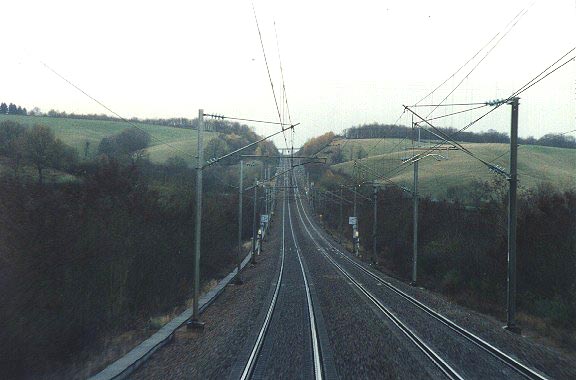
Not that the network is that good in France though, Paris-Lyon-Marseilles has been nice for years, the connection to Lilles (and now to Bruxelles in Belgium as well) and to London via the channel tunnel is nice, a line recently opened to the east of the country (Strasbourg) but the TGV network has a few glaring issues:
* Everything goes through Paris. Lyon-Paris takes 3 hours, Paris-Strasbourg take about the same time, but a direct from Lyon to Strasbourg (not via Paris) takes 6 hours even though there is pretty much the same distance (~450km) betweem all of them (yep, Paris-Lyon-Strasbourg almost forms an equilateral triangle). Likewise Paris-Marseille (800km) takes 4h but Marseille-Nice (south-east to south-east but further east, 200km) will be 3h30
* There are no LGV (high-speed train lines) to western France, they stop at Le Mans and Tours (200~250km from Paris) so travelling from Paris to Marseille (800km) takes 4h, and Paris to Bordeaux (550km) will take you 4h as well (as the TGV has to use regular lines for half the travel). Paris to Toulouse (670km direct, 780km via Bordeaux) will waste at least 7h (TGV to Bordeaux then regional train).
Thankfully this is changing, there are new lines in the work and projected to start solving this issue (see dotted lines: http://en.wikipedia.org/wiki/File:France_TGV.png) and overall TGV is awesome, but it's nowhere near perfect right now.
PS: I note that my timings differ from Spiegel's, I got mine from the SNCF database so...
PPS: For those unfamiliar with french geography and cities, Paris is of course the french capital (inner city population 2.2M, 11.7M including suburbs), Marseilles is France's second biggest city (852k inner, 1.6M metro), Lyon comes third (472k inner but 1.75M metro), Toulouse is the fourth biggest (437k inner, 1.1M metro), Nice stands at 5th (348k inner, 990k metro), Strasbourg 7th (273k inner, 638k metro) and Bordeaux is 9th (250k inner, 1M metro)